
Clube Cético
Gatófilos e cachorrófilos do CC
Autor: Fabi | Categoria: Papo Furado | Exibições: 190075 Comentários: 1701

Registrado em:
01/04/2007, 03:49
Comentários: 25226
Tópicos criados: 60
Idioma:
Valeu, é sempre difícil mesmo, principalmente se o bicho está conosco a muito tempo.
O gatão era de uma vizinha e se mudou por vontade própria para minha casa quando fizeram uma grande reforma com pedreiros trabalhando.
Ele veio, entrou e resolveu ficar.
Ele tinha uns 18 anos de vida sendo que pelo menos uns 15 comigo.
Era tão bobão que os outros gatos bem menores o empurravam para o lado enquanto estava comendo, ele esperava eles comerem e continuava depois.
Fará falta, muita falta em casa.
0
0
0
0
0
0
0
Data da postagem: 14/12/2018, 15:50

Registrado em:
27/08/2008, 05:06
Comentários: 12820
Tópicos criados: 55
Idioma:
Citação de: Arcanjo Lúcifer em 13 de Dezembro de 2018, 21:39:24
Meus sentimentos Arcanjo.
Meu gatão cinza tb se foi ontem.
Eu já estava esperando, ele começou a perder peso muito rápido e levei no veterinário, fiz tudo que pude, ele melhorou bastante e voltou a se alimentar bem, piorou, tratei no veterinário, melhorou bastante novamente.
Viveu mais uns meses após a primeira crise e ontem se foi.


Meus sentimentos Arcanjo.
0
0
0
0
0
0
0
Data da postagem: 15/12/2018, 09:32

Registrado em:
07/11/2008, 20:37
Comentários: 5231
Tópicos criados: 35
Idioma:
Olavo de Carvalho também é gatófilo. Um tipo muito especial: especializado em magia de gatos.
"Gato cura dor de cabeça. Como faz? Você olha o gato colocando o olho nele de tal maneira contra a luz de modo que você veja o fundo (que parece uma lua). A hora que a luz bater lá e você olhar a dor de cabeça para. E o gato dorme quinze horas seguidas. Isto é magia. A definição de magia é você operar defeitos físicos através de imagens. Através do olhar. "
Botem este homem para indicar ministros! Não se pode desperdiçar tanta sabedoria.
0
0
0
0
0
0
0
Data da postagem: 15/12/2018, 10:36

Registrado em:
13/10/2005, 05:26
Comentários: 23882
Tópicos criados: 297
Idioma:
Citação de: Arcanjo Lúcifer em 13 de Dezembro de 2018, 21:39:24
Lamento, Arcanjo. Força aí.
Meu gatão cinza tb se foi ontem.
Eu já estava esperando, ele começou a perder peso muito rápido e levei no veterinário, fiz tudo que pude, ele melhorou bastante e voltou a se alimentar bem, piorou, tratei no veterinário, melhorou bastante novamente.
Viveu mais uns meses após a primeira crise e ontem se foi.
Lamento, Arcanjo. Força aí.
0
0
0
0
0
0
0
Data da postagem: 15/12/2018, 10:51
Registrado em:
01/04/2007, 03:49
Comentários: 25226
Tópicos criados: 60
Idioma:
Valeu pessoal.
Pela idade dele eu já meio que esperava.
A melhor lembrança que eu tenho desse bicho era dele cuidando de um filhote de gato que nós tivemos, ele sempre cuidava dos gatos menores que apareciam por aqui.
Gato sempre briga pelo seu espaço particular mas ele nem se importava.
0
0
0
0
0
0
0
Data da postagem: 15/12/2018, 11:13

Registrado em:
05/10/2006, 07:41
Comentários: 3824
Tópicos criados: 21
Idioma:

Siegfrieda. Também conhecida como Zizi, Zigui, Scheißchen e /pɫ̩pɫ̩/, que não sei como escrever. Chegou espancada aqui em casa num natal desses, a idéia era tratá-la e doá-la, mas foi ficando... ficando...
Tem o péssimo costume de virar de barriga pra cima, como se dissesse "olha como sou bonitinha!" quando leva bronca. Um dos bichos mais dóceis que já conheci.
0
0
0
0
0
0
0
Data da postagem: 11/02/2019, 21:06
Registrado em:
01/04/2007, 03:49
Comentários: 25226
Tópicos criados: 60
Idioma:
Que bom que vc ficou com ela.
Quem não conhece o comportamento dos gatos acha que eles não estão nem aí com as pessoas da casa mas não é assim, eles se apegam como os cães fazem.
O meu gato sempre esperava eu chegar em casa e me acompanhava para todo lado.
0
0
0
0
0
0
0
Data da postagem: 12/02/2019, 02:49
Registrado em:
05/10/2006, 07:41
Comentários: 3824
Tópicos criados: 21
Idioma:
Não tinha como não ficar com ela. Ela se apegou a nós, e nós a ela. Extremamente amorosa e doce, agora mesmo tá dormindo próxima ao meu pé e, se saio de perto, levanta pra me acompanhar. (De vez em quando ergue a cabeça, mia, só volta a dormir depois que falo com ela.)
E a outra gata (a Kika) já deixou claro que tolera a Sieg, contanto que a Sieg não encha o saco dela.
Citar
Eles fazem isso bastante. A Kika fica na sacada quando está sozinha, pra ver quando chega alguém em casa.
E a outra gata (a Kika) já deixou claro que tolera a Sieg, contanto que a Sieg não encha o saco dela.
Citar
O meu gato sempre esperava eu chegar em casa e me acompanhava para todo lado.
Eles fazem isso bastante. A Kika fica na sacada quando está sozinha, pra ver quando chega alguém em casa.
0
0
0
0
0
0
0
Data da postagem: 14/02/2019, 00:40

Registrado em:
27/01/2005, 00:05
Comentários: 37936
Tópicos criados: 1126
Idioma:
Há questões análogas sobre o cultivo de deformações extremas em cães:
Citar
Citar
Citar
https://www.insidescience.org/news/large-dogs-age-faster-die-younger
https://www.sciencemag.org/news/2017/01/why-large-dogs-live-fast-and-die-young
Citar
http://messybeast.com/brachycephaly.htm
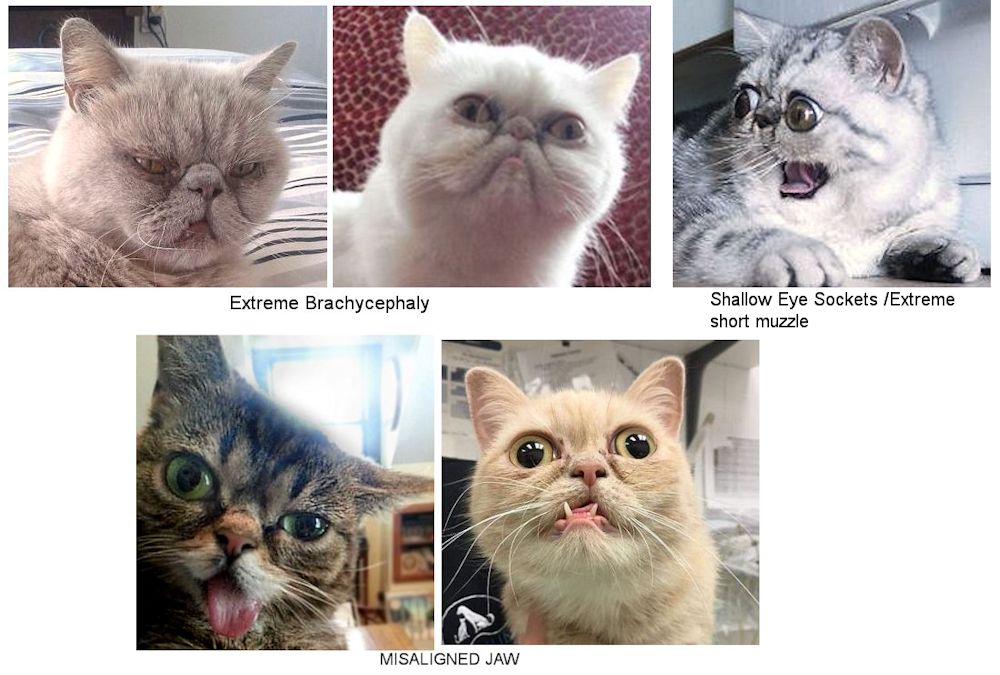
THE ETHICS OF BREEDING FOR DEFORMITY: EXTREME BRACHYCEPHALY
Copyright 2010, 2018 Sarah Hartwell
Owners of Persians and Exotic Shorthairs are advised by cat care books that these breeds may have problems grooming, have dribbling eyes and overcrowded teeth. Roger Tabor noted, in "The Rise of the Cat", that exhibitors had to continually wipe the dribbling eyes of Persian cats. Cats are instinctively fastidious animals and the inability to groom properly and the constant tears must frustrate them. Owners have noticed that these cats tend to eat by flinging food upwards to catch it in the mouth. There is even biscuit food aimed at Persians where the pieces are designed to be scooped up with the tongue (anyone doubting this problem should try to eat cat-style, after all Persian/Exotic faces are becoming almost as flat as ours). In the most extreme case, that of the Peke-Faced Persian, the high palate meant many kittens were unable to suckle effectively and had to be hand-reared. Modern extreme-typing (ultra-typing) has led to Persians approaching the level of deformity and handicap founded in the Peke-Faced Persian.
Reports on the problems associated with short muzzles have often been dismissed by fanciers as rants from people who don't appreciate the aesthetics of the modern breeds. Health problems have been downplayed by breeders and registries as alarmist or overstated, but there is a growing body of veterinary evidence showing the problems associated with the facial anatomy of modern Persians/Exotics. This article looks at veterinary research into the effects of the flattened face as well as legislative measures that might come into play if cat fanciers continue to value extreme conformation over feline health and if registries do not rein in these excesses.
[...]
[...]
Neurological assessment found that all the doll-faced Persians were clinically sound. However, in the peke-faced (extreme) Persians:
14 (66%) were obtunded (dulled alertness) and unresponsive to external stimuli.
8 (38%) lacked the menace responses with preserved pupillary light reflexes indicating a visual impairment.
6 (28%) did not react to sound (only one of the deaf cats was white and its eyes were copper).
3 (14%) showed delayed hopping and wheelbarrowing reactions (hopping is where the forelimbs are supported, wheelbarrowing is where the hindlimbs are supported – the normal reaction is to immediately hop or walk the unsupported limbs).
7 (33%) lacked postural reactions.
12 (57%) had mild ataxia (tremor, incoordination).
5 kittens (23%) from 3 different litters had severe ataxia in all four limbs and were unable to stand most of the time. They had dulled alertness, mild head tremors and degrees of nystagmus (flickering eye movements) and strabismus (crossed eyes) and an abnormal breathing pattern. The owners reported these kittens had long periods of aimless screaming. Due to their severe clinical signs these kittens were euthanised.
Compared to both domestic shorthairs and doll-faced Persians, peke-Face Persians had grossly reduced cranial length and increased width and height. The eye orbits were shallow, wide-set and tended to diverge, and the bone between the eyes was indented. The frontal sinus was small or absent in all peke-face cats. The nasal bone was found to be notably short, or even absent. The lower jaw protruded and tilted upwards. The ventral nasal passages were obstructed. A 6 year old male peke-faced Persian showed profound aberrations compared to the other cats.
[...]
CONFORMATION VS CRUELTY - TIME TO REWRITE BREED STANDARDS
Malik, writing in Journal of Feline Medicine and Surgery (2009), suggested enlisting the help of organisations such as the RSPCA to press cruelty charges on the breeders of cats with extreme brachycephaly as they are handicapped and prone to illness and discomfort. In Germany, this is already in place. Extreme brachycephalic cats where the tip of the nose is higher than the level of the lower eyelid, and/or which show other anomalies of the facial bones detrimental to health may not be bred.
[...]
CONCLUSION
At present, surgery may be required to correct the dental and eye problems and improve the quality of life for individual cats. There is a danger that if the obstructing canines are removed, the abnormally routed nasolacrimal duct will be damaged. Some pregnancies may require caesarian deliveries and kittens are at increased risk of umbilical hernia as extremely brachycephalic mothers cannot cleanly sever the umbilical cord.
Not all of the issues are surgically correctable. The extreme change of head conformation means the Persian/Exotic cat's brain is now crowded into the wrong-sized skull. In brachycephalic dogs, this has already been shown to result in syringomyelia resulting in chronic pain, seizures and increasingly abnormal behaviour due to pressure on the brain.
The public are in the position of buying cats that may need extensive and expensive veterinary care to address an array of health issues that go hand-in-hand with the Persian/Exotic conformation. Some of the issues may even necessitate euthanasia. Only by reverting to more moderate conformation can these health issues be avoided.
When surgery is required to alleviate the health problems caused by extreme breeding, it is obvious that breeders have already taken conformation changes too far. When the cats have problems eating due to their face shape, the breed is clearly in serious trouble. Once females have problems giving birth normally and kittens have problems suckling, the breed is dangerously close to being non-viable.
The dog fancy in the UK has already been subjected to scrutiny by the media, by welfare organisations and even by the government over health issues caused by dog breed standards and extreme typing. if the cat fancy wishes to avoid similar scrutiny, it needs to recognise and address the issue rather than dismissing it as the views of outsiders. If adverse publicity means the public are no longer willing to buy extreme brachycephalic cats then breeders will be unable to sell or home their kittens and may be forced to stop breeding. Legislation may even force the issue and take the matter out of breeders' hands if they are unwilling to undo the damage caused by extreme brachycephaly and brachygnathia.
Citar
https://en.wikipedia.org/wiki/Bulldog
[...] Over 80% of Bulldog litters are delivered by Caesarean section[22] because their characteristically large heads can become lodged in the mother's birth canal. The folds, or "rope", on a Bulldog's face should be cleaned daily to avoid infections caused by moisture accumulation. [...]
Citar
https://ibcdogs.org/64-2/
[...] Among biologists, veterinarians, and genetic researchers, there is no controversy over the cause of the growing list of genetic disorders in dogs. The genome of every animal harbors many mutations that are passed from generation to generation with no harmful effects because they are recessive. Most genetic disorders in dogs are not caused by a new mutation, but by mutations that are ancient, originating in some animal hundreds or even thousands of generations ago, or perhaps even a legacy of the progenitor wolf. These mutations result in a genetic disorder when a dog inherits two copies. The increasing burden of genetic disease in purebred dogs is a direct and predictable consequence of breeding practices that increase the expression of deleterious alleles.
Here are some examples of what the experts say:
Citar“Intense selection, high levels of inbreeding, the extensive use of a limited number of sires, and genetic isolation are all hallmarks of modern breeds of domestic dog. It is widely agreed that part of the collateral damage from these practices is that purebred dogs have a greater risk of suffering from genetically simple inherited disorders than their cross-breed cousins.” (Mellersh 2012)“The indirect effects of selective breeding for appearance include very significantly reduced genetic diversity unevenly spread across the genome, resulting in elevated prevalence of specific diseases within particular breeds. Coupled with ill-advised breeding practices and insufficient selection pressure on health and welfare, this has led to certain breeds becoming especially susceptible to a whole suite of disorders, many of which are acutely painful or chronically debilitating…Since many diseases are the consequence of homozygosity for recessive alleles, breeding of close relatives is accompanied by a corresponding increase in the occurrence of these disorders…because an animal must inherit one defective gene from each parent in order to develop the condition. When parents are closely related, the liklihood of them both carrying a copy of the same deleterious gene is significantly elevated.” (Rooney & Sargan 2009)“Since their domestication, dogs have undergone continual artificial selection at varying levels of intensity, leading to the development of isolated populations or breeds. Many breeds were developed during Victorian times and have been in existence for only a few hundred years, a drop in the evolutionary
bucket. Most breeds are descended from small numbers of founders and feature so-called popular sires (dogs that have performed well at dog shows and therefore sire a large number of litters). Thus, the genetic character of such founders is overrepresented in the population. These facts, coupled with breeding programs that exert strong selection for particular physical traits, mean that recessive diseases are common in purebred dogs and many breeds are at increased risk for specific disorders.” (Ostrander 2012)
“Conditions not relating directly to breed standards account for over 75% of all inherited disorders in pedigree dogs and have been attributed to breed formation and small effective population size, the repeated use of popular sires and inbreeding. The development of the breeds has been associated with the increasing prevalence of a large number of genetic diseases.” (Farrell et al 2015)
[...]
https://www.insidescience.org/news/large-dogs-age-faster-die-younger
https://www.sciencemag.org/news/2017/01/why-large-dogs-live-fast-and-die-young
0
0
0
0
0
0
0
Data da postagem: 27/07/2019, 09:27

Registrado em:
12/05/2011, 04:16
Comentários: 11573
Tópicos criados: 87
Idioma:
X K9
0
0
0
0
0
0
0
Data da postagem: 05/12/2019, 11:24