
Clube Cético
Kardec arrependeu-se do Espiritismo?
Autor: Gigaview | Categoria: Religiões, Crenças e Mitos | Exibições: 68228 Comentários: 673

Registrado em:
01/04/2015, 13:01
Comentários: 1743
Tópicos criados: 9
Idioma:
ATENÇÃO: a seguinte imagem não é uma fraude!
Médium materializando ectoplasma real. Percebam que primeiro começa a se materializar os óculos do defunto.

Médium materializando ectoplasma real. Percebam que primeiro começa a se materializar os óculos do defunto.
0
0
0
0
0
0
0
Data da postagem: 14/10/2016, 19:33

Registrado em:
07/11/2008, 20:37
Comentários: 5231
Tópicos criados: 35
Idioma:
Citação de: Alquimista em 14 de Outubro de 2016, 23:33:55
Não estou convencido disso.
Não estou convencido mesmo!
Pra mim são as duas orelhas...
ATENÇÃO: a seguinte imagem não é uma fraude!
Não estou convencido disso.
Não estou convencido mesmo!
Pra mim são as duas orelhas...
0
0
0
0
0
0
0
Data da postagem: 14/10/2016, 19:44
Registrado em:
01/04/2015, 13:01
Comentários: 1743
Tópicos criados: 9
Idioma:
Citação de: Pedro Reis em 14 de Outubro de 2016, 23:44:43
Ou coisa pior!!!!! (Duas bolas????)
Citação de: Alquimista em 14 de Outubro de 2016, 23:33:55ATENÇÃO: a seguinte imagem não é uma fraude!
Não estou convencido disso.
Não estou convencido mesmo!
Pra mim são as duas orelhas...
Ou coisa pior!!!!! (Duas bolas????)
0
0
0
0
0
0
0
Data da postagem: 14/10/2016, 19:56

Registrado em:
05/07/2011, 07:59
Comentários: 18108
Tópicos criados: 130
Idioma:
Citação de: Buckaroo Banzai em 14 de Outubro de 2016, 21:10:39
+ Fraude detect
ué ! como isso é possível a médium esta incorporando o espirito do Ermeto pascoal ,mas ele ainda não morreu!

Até hoje não há provas de que não foram usados duendes REAIS nesse episódio de Chapolim:
* não necessariamente, os espíritos aparecem em tamanhos variados:

+ Fraude detect
ué ! como isso é possível a médium esta incorporando o espirito do Ermeto pascoal ,mas ele ainda não morreu!
0
0
0
0
0
0
0
Data da postagem: 15/10/2016, 04:57

Registrado em:
27/01/2005, 00:05
Comentários: 37936
Tópicos criados: 1126
Idioma:
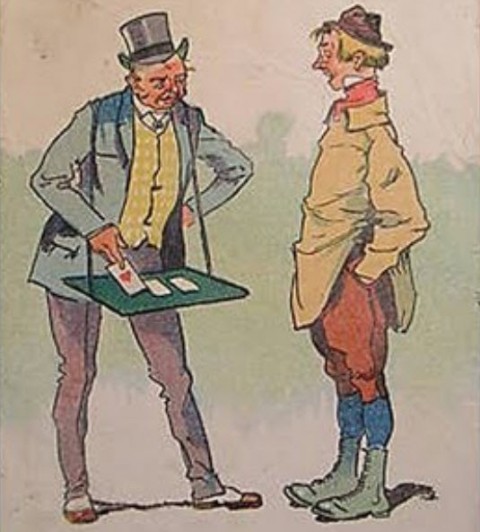
Outra área em que paranormais e médiuns são raramente investigados são naqueles jogos de rua, onde você tem que descobrir sob qual xícara, copo, concha, ou casca de noz está alguma coisa, ou mesmo, apenas acompanhar qual carta você escolheu, dentre três.
As pessoas comumente acham que se trata de um "truque" materialista simples, muito embora não esbocem reação se pedimos para demonstrar como seria feito. Não conseguem fazê-lo.
Evidentemente esses "truques" contam com colaboração de fantasmas, que, invisíveis, são os comparsas perfeitos. Não são só invisíveis, mas podem invisibilizar e até intangibilizar coisas materiais em que tocam, ao transferir sua freqüência de vibração quântica aos objetos.
Em 1867 teve um hábil mestre nesses jogos com quem Alfred Russell Wallace teve contato. Ele nunca conseguiu desmascará-lo, confirmando definitivamente seus poderes mediúnicos reais e toda a realidade espiritual, especificamente como descrita pelo kardecismo, ao menos segundo meus autores preferidos. Parece que nem mesmo Thomas Henry Huxley foi capaz de dissuadí-lo. Esse é um capítulo negro na história do evolucionismo materialista, que prefere excluir esses inconvenientes ideológicos a sua fé até como notas de rodapé.
Este homem sabia que fotografias podiam eventualmente capturar fantasmas e então habilmente nunca se permitiu ser fotografado para jornais:
E era Vitoriana foi realmente uma espécie de apogeu científico fora do seu tempo, tendo entrado numa nova "era das trevas" com o materialismo fundamentalista do século XX. Vejam só como estava a pesquisa de Inteligência Artificial naquele tempo:
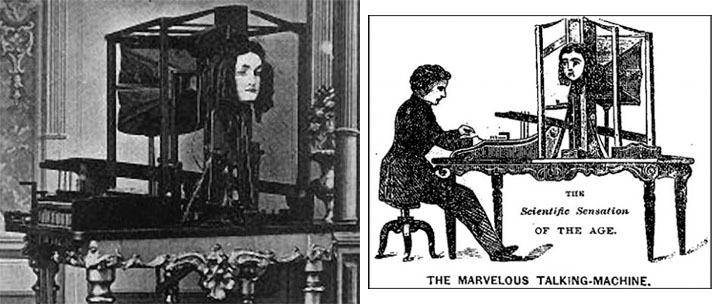
Coisas assim nos parecem "novidade" quando são publicadas nos jornais em recentes décadas, mas se trata apenas de conhecimento esquecido.

As pessoas comumente acham que se trata de um "truque" materialista simples, muito embora não esbocem reação se pedimos para demonstrar como seria feito. Não conseguem fazê-lo.
Evidentemente esses "truques" contam com colaboração de fantasmas, que, invisíveis, são os comparsas perfeitos. Não são só invisíveis, mas podem invisibilizar e até intangibilizar coisas materiais em que tocam, ao transferir sua freqüência de vibração quântica aos objetos.
Em 1867 teve um hábil mestre nesses jogos com quem Alfred Russell Wallace teve contato. Ele nunca conseguiu desmascará-lo, confirmando definitivamente seus poderes mediúnicos reais e toda a realidade espiritual, especificamente como descrita pelo kardecismo, ao menos segundo meus autores preferidos. Parece que nem mesmo Thomas Henry Huxley foi capaz de dissuadí-lo. Esse é um capítulo negro na história do evolucionismo materialista, que prefere excluir esses inconvenientes ideológicos a sua fé até como notas de rodapé.
Este homem sabia que fotografias podiam eventualmente capturar fantasmas e então habilmente nunca se permitiu ser fotografado para jornais:
E era Vitoriana foi realmente uma espécie de apogeu científico fora do seu tempo, tendo entrado numa nova "era das trevas" com o materialismo fundamentalista do século XX. Vejam só como estava a pesquisa de Inteligência Artificial naquele tempo:
Coisas assim nos parecem "novidade" quando são publicadas nos jornais em recentes décadas, mas se trata apenas de conhecimento esquecido.
0
0
0
0
0
0
0
Data da postagem: 15/10/2016, 06:19

Registrado em:
04/10/2016, 06:26
Comentários: 147
Tópicos criados: 0
Idioma:
Atendendo a alguns pedidos:
The Mentalist Who Baffled Sir William Crookes
Massimo Polidoro
The Skeptical Inquirer, 1 January of 2000
http://business.highbeam.com/5799/article-1G1-58545669/anna-eva-fay
Between 1870 and 1874 the eminent scientist William Crookes conducted a series of controversial experiments with some of the most remarkable mediums of the age. One episode shows without a doubt Crookes’s failure to detect open trickery. This happened when Crookes met Annie Eva Fay, an interesting personality, now largely forgotten, who deserves to be remembered.
Between 1870 and 1874 William Crookes--the discoverer of thallium, inventor of the radiometer, developer of the Crookes tube, pioneer investigator of radiation effects, Fellow of the Royal Society, and later knighted--conducted a series of experiments with some of the most remarkable mediums of the age. D. D. Home, possibly the greatest medium of all, was studied by Crookes and declared genuine, as were Florence Cook, a young woman specialized in the materialization of a ghost named “Katie King”; Kate Fox, one of the originators of spiritualism, later self-confessed fraud; Mary Rosina Showers, another young materializing medium; and Annie Eva Fay, a vaudeville entertainer (Brandon 1984; Polidoro 1995).
There are some very strong doubts about the validity of these investigations; for example, it has been claimed that the married Crookes had a love affair with Florence, and that the experiments were just a ruse for their meetings (Hall 1984). Crookes’s supposed complicity with the medium, or his inability to conduct reliable, scientific tests in spiritualism, are still debated today. There exists, however, at least one episode that shows without a doubt Crookes’s failure to detect open trickery when confronted with it. This happened when Crookes met Annie Eva Fay, an interesting personality, now largely forgotten, who deserves to be remembered.
The “Indescribable Phenomenon”
Annie Eva Heathman was born in Southington, Ohio, in the 1850s (she preferred to keep the exact date to herself). She left home quite young and became interested in theosophy and mysticism. At one time she said that she became Mme. Blavatsky’s pupil, living with her and helping her in her work. When she left, along with a handsome shawl presented to her by Mme. Blavatsky, Annie had to earn her own living and decided to go on stage as a mind-reader, a specialty she presented until her last performance in Milwaukee in 1924.
Her first public performance as a psychic entertainer took place in a schoolhouse in New Portage, Ohio. When she married her first husband, Henry Cummings Melville Fay, a self-proclaimed medium, they decided to work on stage as a couple and presented an intriguing performance.
Annie took her place on a stool in an open-front cabinet. A few volunteers, supervised by Melville Fay, would tie her to the stool. One tied her left wrist at the center of a long strip of cloth with many knots, one on top of another; a second volunteer followed suit with her right wrist. She held her hands behind her back as they bound the two strips together and knotted the cloth to a harness ring that was securely embedded in an upright post at the rear of the cabinet. Another piece of tape was tied at the back of the medium’s neck, and the ends were fastened to a staple higher on the same post. One end of a long rope was lashed around her ankles; the other was held by a spectator throughout the performance that followed.
After Annie appeared to go into a trance, Melville Fay would place a hoop in her lap and closed the curtain at the front of the cabinet. A second later he threw open the drape: the hoop now encircled Annie’s neck. Removing the hoop, he placed a guitar on his wife’s lap, closed the curtain and strumming sounds were heard. As soon as he would open the drape, the music stopped and the guitar fell on the floor. The same thing happened with other musical instruments. Other phenomena followed: nails were hammered into a block of wood and paper dolls were snipped from a piece of paper. Finally, a knife was placed in Annie’s lap. Though the curtain was closed for only a few seconds, the spirits seemingly had time to sever her bonds. She stood up and came forward to take numerous bows (Christopher 1975).
The Fays billed their demonstration as “The Indescribable Phenomenon,” never quite openly claiming spirit intervention. Actually, theirs was a typical magic performance, introduced first by Laura Ellis, following the steps of other similar performances, like the Davenports’ “Spirit Cabinet” (Polidoro 1998), which combined escapology and spiritualistic themes. A perfect rendition of the “Indescribable Phenomenon” is still performed today by mentalists Glenn Falkenstein and Frances Willard. Annie was bold enough to feature tricks and illusions along her main act: a “Spirit Dancing Handkerchief,” a “Rapping Hand,” and a “Levitation” were included for years on her program.
At the time few in America considered their performance a real example of spiritualism. Emma Hardinge, a medium and historian of spiritualism, in her book Modern American Spiritualism (1870), had stated that Melville Fay’s deceptions had been “openly exposed by the Spiritualists themselves”; John W Truesdell, a skeptic of the time, agreed that Fay was a rascal. It seems clear that Annie’s claims adjusted to her audience: When dealing with spiritualists, she claimed mediumistic powers, and when performing on the music-hall stage she let the audience be the judge, an attitude adopted by other mentalists of the time, such as the Piddingtons.
Scientists and Magicians
When the Fays reached London in June 1874, the advertisements for their performances at the Queen’s Concert Rooms, Hanover Square, mentioned “entertainments comprising light and dark seances every day,” “mysterious manifestations,” and “series of bewildering effects”; however, there is no suggestion that they had any relation to spiritualism. This notwithstanding, Annie found herself hailed as a physical medium.
Immediately, she started receiving the attention of various psychical researchers; F. W. H. Myers, for example, later to be one of the leading founders of the Society for Psychical Research, had expressed interest in an “extensive investigation of Mrs. Fay’s mediumship.” William Crookes, however, had stated clearly that he wanted to be first in examining her.
In an interesting comment made in a letter by Myers to his colleague Sidgwick the former says, after mentioning Crookes, that “the lion will not let himself be robbed of his cub--nor the cub of her lion,” suggesting that Crookes was trying to make Eva his personal protegee and that Eva was not averse to acting in such a role (Dingwall 1966).
It was about this time that John Nevil Maskelyne and George Alfred Cooke, two well-known British magicians who owned their own theatre at Egyptian Hall and had already exposed the tricks used by the Davenport brothers, added to their show “An Indescribable Seance,” with Cooke, tied in the same way as the American, duplicating her feats.
It was possibly to counteract this exposure that Annie Eva Fay, a vaudeville performer who had found herself the center of a body of eminent literary and scientific men, being treated as a “medium” whom it was necessary to “investigate,” succumbed to temptation and accepted her new role. If the psychical researchers were determined on her being a medium, then she would agree and cash in on it while she could, thus restoring her reputation and promoting public interest in her performances.
The most important of all the experiments conducted on Annie’s “mediumship” were by far Crookes’s “electrical tests,” held at his own home in February 1875 (Crookes 1875).
For these seances, Cromwell F. Varley, another Fellow of the Royal Society, had provided an electrical control circuit, a slightly modified version of the one used by Crookes with medium Florence Cook. To make sure that the medium, seated in a curtained cabinet, could not slip her bonds, Crookes asked her to clench both handles of a battery, constructed as to interrupt the current if she let go of either handle, and send the meter to 0. Fay managed, somehow, to present her manifestations though the contact remained unbroken.
For a further seance, two of the guests were more skeptical than their host. When they inspected the electrical-control system, before the session began, they discovered that a damp handkerchief stretched between the handles would keep the circuit open. At the suggestion of one of these men, Crookes nailed the handles so far apart that a handkerchief could not span them. Apparently no one considered the possibility that a longer strip of cloth or some other type of resistor might be used.
Success at these experiments fueled Annie’s tour of the English provinces; however, when she opened at Birmingham, in May, she was again described as the “Indescribable Phenomenon” and her show billed as an entertainment (Dingwall 1966). Apparently, at the end of her tour, her manager, dissatisfied with the fact that the scientists’ investigations did not produce any money into his pockets, wrote to J. N. Maskelyne suggesting to arrange a public exposure of his ex-client. He offered to reveal for a substantial sum of money how the Crookes experiments had been faked. Maskelyne declined the offer, so the impresario wrote again presenting him Miss Lottie Fowler, another pretty mystic who could do the Fay tricks and went on tour with the same routine when Annie left England.
Exposures and Confession
Exposures of Annie’s performance appeared occasionally in the press. On April 12, 1876, Washington Irving Bishop, a former member of Fay’s American troupe, later to become himself one of the greatest mentalists of all rime, revealed to the New York Daily Graphic how her tricks were accomplished. Unruffled by the exposure, she continued her work with usual success and reinserted her mind-reading act in her program. Pads were distributed, and members of the audience were invited by her husband to write questions, sign their names, tear off the sheets and hold the pieces of paper folded in their hands. Later, Annie, blindfolded, divined correctly the content of the sheets of paper and answered to the questions written on them. She called this portion of the show “Somnolency,” adapted from “Somnomancy,” the name Samri S. Baldwin, “The White Mahatma,” had given to the act that he had invented.
In 1906 H.A. Parkyn, editor of the magazine Suggestion, contributed a long article on the trick methods used by Miss Fay in her billet-reading tests, describing the preparation of the pads and the use of confederates among the audience. This “exposure” was hardly necessary, since it was at this time that she was stating in her program that credulous and foolish persons should not be influenced by her performance since she was “not a spiritualistic medium” and there was nothing “either supernatural or miraculous” about her performance.
In spire of the disavowals of any supernatural power, further exposures occurred in February 1907, when Professor W. S. Barnickel described some of her methods and in January 1911, when Albini, the magician, exposed her “Somnolency” act; still, the public filled theatres where she was featured.
Her son, John T. Fay, married Anna Norman, one of the assistants of Eva’s show, left home, and set up on his own with his wife, calling themselves “The Fays.” When John died in 1908, his widow set up her own show and billed herself as “Mrs. Eva Fay, The High Priestess of Mysticism.”
Obviously, Annie resented her using a stage name so similar to her own, but never took legal action to stop her.
In 1912 Annie visited Europe again and when she reached London, where she performed at the Coliseum, the spiritualists were still ready to marvel at her supernatural powers. One of them, J. Hewat McKenzie, claimed he had been able to discover Eva’s secret: he said her manifestations were done by a small pair of materialized hands and arms, somewhat like those of a monkey, that protruded from her chest. He knew because he had been able to “smell the odour from the emanation of the psycho-plastic matter” during a performance. This same man would later claim he knew how Houdini performed his escapes: by “dematerializing his body,” of course (Doyle 1930).
During her visit, psychic researcher and magician Eric J. Dingwall, who described her as “extremely prepossessing with a perfect complexion and sparkling blue eyes,” was successful in getting her proposed and elected as the first Honorary Lady Associate of the Magic Circle (Dingwall 1966).
For another eleven years she continued to attract capacity crowds wherever she performed. Due to an accidental injury, she played her final engagement in Milwaukee in 1924. In July of the same year she received a visit from Harry Houdini.
Houdini considered her “one of the cleverest mediums in history” and noticed her “straw diamond white” hair and penetrating eyes, from which “great big streaks of intelligence would flash in and out.” “It is small wonder,” he observed, “that with her personality she could have mystified the great mental giants of the ages--nor our age, but of the ages” (Silverman 1996).
They talked for hours and she revealed to him all her secrets. “She spoke freely of her methods,” Houdini noted. “Never at any time did she pretend to believe in spiritualism.” She told him how she had tricked Crookes at the electric test: She had simply gripped one handle of the battery beneath her knee joint, keeping the circuit unbroken but leaving one hand free to do as it wished.
A year later she announced her plan to leave the ten houses on her Melrose Heights property to destitute actors and actresses, but she died on May 20, 1927, before working out the final details of her project.
Annie Eva Fay’s revelation to Houdini of the way she had gulled Crookes was confirmed years later when psychical researcher Colin Brookes-Smith found one of the galvanometers used by Crookes at the Science Museum in London. The machine was repaired and brought to working order.
Brookes-Smith reports that “there was no difficulty at all in sliding one wrist and forearm along over one handle and grasping the other handle, thereby keeping the circuit closed through the forearm, and then releasing the other hand without producing any large movement of the galvanometer spot.” In a second test, he “tucked both electrodes successively right down into my socks and let go so that my hands were free without producing any large galvanometer spot excursions.” In this way, not only did he confirm Eva’s revelation but also “Houdini’s 1924 footnote explanation (p. 102) that in 1874 Florence (Cook) could have detached one of the electrodes consisting of a gold sovereign and saline soaked blotting-paper pad from one wrist and held it under her knee” (Brookes-Smith 1965).
There is no more doubt, now, that trickery actually took place during Crookes’s tests, exactly as described by Annie Eva Fay; what is unclear is whether he was a complete fool (unlikely) or a willing accomplice. In any case, one thing can’t be denied: the great William Crookes had a special interest in attractive, young mediums needing a scientific pedigree and was willing to test them all, even if they were outright fakes like Eva Fay, in his own house, right under his wife’s nose.
Massimo Polidoro is Executive Director of CICAP (the Italian Committee for the Investigation of Claims of the Paranormal), European representative for the James Randi Educational Foundation, author of various books dealing with critical examination of paranormal claims and a graduate student in psychology at Padua University. He is currently working on a hook for Prometheus Books on the strange friendship between Harry Houdini and Sir Arthur Conan Doyle.
References
Brandon, R. 1984. The Spiritualists. Reprint. Buffalo, N.Y.: Prometheus Books.
Brookes-Smith, C. 1965. Cromwell Varley’s Electrical Tests. Journal of the Society for Psychical Research 723 (43), March.
Christopher, M. 1975. Mediums Mystics & The Occult. New York: Thomas Y Crowell Co.
Christopher, M. [1973] 1996. The Illustrated History of Magic. Reprint, Porthsmouth, N.H.: Heinemann.
Crookes, W. 1875. A Scientific Examination of Mrs. Fay Mediumship. The Spiritualist, 12 March.
Dingwall, E. J. 1966. The Critics’ Dilemma. Crowhurst, Sussex: Privately printed.
Doyle, A. C. [1930] 1992. The Edge of the Unknown. Reprint, New York: Barnes & Noble, Inc.
Hall, T. [1962] 1984. The Medium and the Scientist. Reprint, Buffalo N.Y.: Prometheus Books.
Houdini, H. [1924] 1972. A Magician Among the Spirits. Reprint, New York: Arno Press.
Polidoro, M. 1995. Viaggio tra gli spiriti. Varese: Sugarco.
Polidoro, M. 1998. Houdini and Conan Doyle: The Story of a Strange Friendship. SKEPTICAL INQUIRER 2(22), March/April.
Thompson, G. T. 1964. Mrs Fay’s Mediumship. Journal of the Society for Psychical Research 721 (42), September.
Silverman, K. 1996. Houdini!!! The Career of Ehrich Weiss. New York: Harper Collins.
COPYRIGHT 2000 Committee for the Scientific Investigation of Claims of the Paranormal
COPYRIGHT 2003 Gale Group
0
0
0
0
0
0
0
Data da postagem: 15/10/2016, 17:34
Registrado em:
04/10/2016, 06:26
Comentários: 147
Tópicos criados: 0
Idioma:
O Texto abaixo é um extrato da biografia de Crookes e seus experimentos. Só peguei a parte referente a Ana Eva Fay.
PROCEEDINGS OF THE SOCIETY FOR PSYCHICAL RESEARCH VOLUME 54, PART 195, MARCH 1964
WILLIAM CROOKES AND THE PHYSICAL PHENOMENA OF MEDIUMSHIP
BY R. G. MEDHURST AND K. M. GOLDNEY
The authors are indebted to Mr Mostyn Gilbert for having suggested this
project, and for having carried out investigations in connection with it. He
wishes it to be known, however, that he does not necessarily concur in the
present authors' interpretation of the evidence, and reserves the right to
publish his own interpretation.
Note: References to some of the original material found by the authors in
the course of their researches and originating in the files of the Society have
appeared recently in various publications. The Society wishes it to be
understood that this was done without the consent either of the authors or of
the Society.
'For nearly twenty-five years I have been attacked on account of these experiments,
and I have not replied. All the attacks I have seen have been criticisms
of one or two isolated experiments or statements I have made, with an entire
avoidance of other passages which would explain the former. They have been
written more with the object of showing I was wrong and untrustworthy than
with the object of getting at the real truth.... When the 'higher criticism' appears
in which all I have written on the subject is compared, collated and reviewed, I
have no anxiety as to the result.'
SIR WILLIAM CROOKES, Journal S.P.R.
Vol. IX, November 1900, p. 324
'It is almost as difficult to resist the testimony as it is to accept the things
testified.'
SIR OLIVER LODGE, Proceedings S.P.R.
Vol. XVII, March 1902, p. 45
8. CROOKES AND MRS FAY
Mrs Annie Eva Fay was an American medium whose speciality
was the allegedly paranormal movement of objects remote from
her while she herself was, ostensibly, fastened to her chair. She
gave stage performances in London during most of 1874 which,
1 Light, August 28, 1926, p. 405.
Proceedings of the Society for Psychical Research [VOL. 54, PT. 195
though purporting to be of mediumistic origin, were advertised
by bills very like those announcing conjuring performances.1 As
James Burns (an active Spiritualist and editor of The Medium and
Daybreak) said:2
The genuineness of Mrs. Fay's mediumship has been widely questioned
— as indeed, has been the probity of every other medium —
more particularly because she permitted herself to be advertised and
exhibited in showman fashion. The phenomena occur at her seances
with such pre-arranged regularity, that many cannot escape the
suspicion that the experiments are a series of tricks, inscrutable to the
public, but capable of imitation by experts.* Others again boast
that they can permit themselves to be tied and then perform 'all her
tricks'. At the present moment the showman who worked her
seances at Hanover Square is now imitating her manifestations by the
reproduction of the old advertisement and the exhibition of a
'phenomenon' in the very unspiritual figure of a young lady in tights!
Looked at from all sides, the genuineness of Mrs. Fay's mediumship
involved a most important issue, the relations of which may be easily
filled in by the reader, and to set all doubts at rest on the matter Mr.
Crookes's experiments were successfully directed.
* Those accustomed to investigate with well-developed mediums,
are favoured with an almost equal certainty and regularity of the
phenomena. The objections raised against mediums are often unnecessary,
and sometimes malicious. (Burns's footnote.)
Mrs Fay's mediumship would certainly be forgotten today were
it not for Crookes's remarkable tests. Before discussing these, it
will, be of interest to consider some of the events leading up to them.
Unpublished letters of Frederick W. H. Myers, Lord Rayleigh
and Henry Sidgwick make it clear that, late in 1874, a scheme was
being canvassed for an extensive investigation of Mrs Fay's
mediumship. This was to be carried out by a team consisting of
Myers, Crookes, Sidgwick, Rayleigh, and probably Edmund
Gurney. Such an undertaking would doubtless have made psychic
history!
According to Myers's unpublished diary, his first sitting with
Mrs Fay was in June 1874, apparently in company with Sidgwick.
Further sittings, sometimes with Crookes present, are recorded for
November and December 1874 and January 1875. The earliest
mention we have seen of the projected formal investigation is in a
letter from Rayleigh to Myers dated November 23, 1874. Myers
had evidently proposed that Mrs Fay be paid three or four hundred
1 For a reproduction of a bill announcing Mrs Fay's performance in 1879,
see John W. Truesdell's The Bottom Facts Concerning the Science of Spiritualism
. . . , G. W. Carleton, New York, 1884.
8 The Medium and Daybreak, March 12, 1875, p. 161.
90
MARCH 1964] The Physical Phenomena
pounds for a lengthy series of sittings, and Rayleigh, while he felt
that this sum 'might be well spent in getting a really satisfactory
demonstration of Spiritualism', had doubts about expending so
much money merely 'on the chance of doing so'. He says:
I do not know what evidence you or Mr. Crookes may have of Mrs.
Fay's genuineness, and so am writing rather in the dark but I should
not consider any number of seances like one we had in Carlton
Gardens worth much. I should attach great importance to the terms
of the arrangement that it may be possible to make, e.g. whether Mr.
Fay is to be eliminated and the general control to be in our hands.
Some sort of agreement was apparently reached with the
medium. In a letter to Sidgwick dated November 26, 1874
Myers writes of Mrs Fay (by then he was referring to her as
'Eva'):
In her engagement with us it is plainly understood that she is to
submit to every conceivable test. The moral evidences of her candour
constantly increase. Each accession of intimacy with her leads me to
an increased respect for her uprightness, courage and kindness.
In the same letter, Myers mentions Eva's opinion that Sidgwick
was a bad sitter.1 She objected to his fidgetiness, and to his being
dissatisfied with precautions after they had been taken. Presumably
this had determined Sidgwick not to sit further with the lady.
In an undated letter2 to Myers he writes:
On reflection, I think I should like to cut off the possibility (which
we left remote and indefinite) of my ever joining in the Fay business.
This is on various grounds, which it wd take long to explain with
proper delicacy — but I will when we meet if I can. Of course I
may change my mind; but at present I feel disposed to leave Mrs. F.
to you and Crookes — bidding her rroXXa x^P^v [many farewells]
as medium. As a friend of yours she will of course always claim my
kind regards & services. Probably in a few years she will come to
regret her treatment of One [evidently Sidgwick!] whose sacrifices
in the cause of Humanity will then have hurried him to a premature
grave — but you need not agitate her mind by these gloomy images.
. . . You must concentrate your resources on Mrs. Fay. The more
Crookes gives himself the airs of tyranny, the more needful it is that
the Commons — if you will not mind being regarded momentarily
as a Commons — should have the power of the Purse.
1 In an undated ms. preserved by the Lodge family, Crookes remarks: 'There
are some people so constituted that nothing psychic will take place in their
presence. Prof. Sidgwick was one. In spite of repeated trials he never witnessed
anything.' 2 This and Sidgwick's subsequent letters are preserved in the library of
Trinity College, Cambridge.
91
Proceedings of the Society for Psychical Research [VOL. 54, PT. 195
In reply to this, in a letter dated December 3, 1874, Myers
remarks:
Alright about your not joining Crookes and me if indeed we do aught
with Eva this winter. But pledge not yourself never to witness her
revelations, for I hope that that sweet and noble one may be permitted
to remain yet some 30 or 40 years in the form, and may under
God's providence be a leading agent in bringing Life and Immortality
to light.
. . . I do not fear Crookes. The lion will not let himself be robbed
of his cub, — nor the cub of his lion.
In a further letter to Sidgwick dated December 9, 1874, Myers
revealed that:
Moses has seen Eva's 'Willy' doing the manifestations for her, —
that is to say another dupe bears witness to the juggler who cannot
appreciate Moralists. (This is sarcasm of the lightest kind.) There is
a crisis in the affairs of Eva. I know not what will happen, but will
write again.... You need not tell Rayleigh about Mr. Fay's past
crimes, as nobody proposes that he should have anything to do with
our investigation, and Eva only told me privily, and would not like
it spread, for his sake.
Sidgwick, in his reply (dated 'Tuesday') writes:
. . . I shall perhaps not come to town on Monday as Rayleigh wants
me to go to Terling — or perhaps I shall go down to him for a night
during the week. He is rather inclined to go in for the Fay business,
I think. I shall urge him as strongly as I can. I think however I
ought to let him know what you told me about the Colonel's 'record'
— but that as you decide.
Myers's proposal not to tell Rayleigh about an obviously very
material circumstance, and Sidgwick's willingness to aquiesce in
this course of action, may be thought to constitute somewhat
disingenuous treatment of a colleague, particularly in view of the
sum of money involved, then a very substantial one. But it is sadly
clear that there was a certain absence of trust between the collaborators.
Besides Sidgwick's comment regarding Crookes's
'airs of tyranny' in the letter quoted above, he remarks in another
letter to Myers:
. . . but in a general way it seemed to be possible that Crookes was
seeing his way to funds from other quarters and would not be sorry
for an excuse to break with you; in order to gain independence and
secure his scientific priority.
For reasons that are not clear the proposed collaborative investigation
of Eva Fay never came to anything. There exists an
92
MARCH 1964] The Physical Phenomena
interesting letter on this subject from Rayleigh to Myers, written
in January 1875. We quote it since it bears on Crookes's attitude
towards the mediums he worked with. By then it would seem that
Crookes had largely taken over the investigation of Mrs Fay.
Terling Place,
Witham, Essex.
15th Jan. 1875.
Dear Myers,
I scarcely see my way to asking Mrs. Fay here again without a
better explanation of her extraordinary conduct, but I have written
to Gurney, and perhaps something may still be arranged.
I received an odd letter from Crookes saying that an explanation
was certainly due to me from Mrs. Fay, but not giving it, as he said
he did not wish to put anything upon paper upon this subject. If
I could give him an interview he had no doubt he could satisfy me
that no other course was open to Mrs. Fay. I do not feel much
disposed to recognise him in the matter at all.
I must confess all these difficulties shake the limited belief that I
had arrived at — probably more than is reasonable. Crookes'
behaviour seems to me so odd that I cannot help attaching less value
to his testimony on which I had mainly relied. What was it to him
whether I was a believer or not? Lady Rayleigh reminds me (what
had passed out of my mind) that Mrs. Jencken told us that Crookes
always tried to prevent her giving a seance without him, and even
urged her to break off definite engagements; and he evidently
behaved very oddly in the matter of her marriage, so that Mr. J.
will not meet him.
I am the more disappointed with Crookes because my first impression
of him was favourable.
Wishing you all success,
Yours very truly,
RAYLEIGH.
We have not been able to discover what were the grounds for
Lord Rayleigh's dissatisfaction, but some understanding must have
been reached, since a month later, Rayleigh attended at least one
of Crookes's electrical tests, which we shall discuss later in this
section.
We conclude this account of the events that preceded Crookes's
tests with a passage from a letter by Myers to Sir Oliver Lodge,
dated March 15,1892. He writes:
My dear Lodge,
I hope indeed that Crookes may be President of Brit. Assn. in 1894.
I do not know any ground on which his honesty could possibly be
93
Proceedings of the Society for Psychical Research [VOL. 54, PT. 195
doubted, unless it were with regard to his getting successful experiments
with Mrs. Fay, who was an undoubted cheat. But the
electrical experiment — which is well known — was of so plain a
character, and the witnesses so capable of judging of it (Lord Rayleigh
etc.), that it seems absurd to ground any charge against Crookes on that
incident.
Another incident happened in a sitting with Crookes, Mrs. Fay,
Edmund Gurney and myself, which did lead E.G. to entertain doubts
as to whether Crookes had not pushed a pleasantry to a point of unjustifiable
mystification. But I am now convinced that the incident
is to be otherwise interpreted. It was thus. We were sitting in pitch
darkness, and Crookes was holding Mrs. Fay's hands. Suddenly a
book which was on Mrs. Fay's knee was thrown with great violence
at E.G., whom Mrs. Fay disliked. This fact — occurring with a
person who, whether medium or no, was certainly also a cheat, —
seemed to show that Mrs. Fay's hands had been loose; and E.G.,
firstly from Crookes's manner, supposed that Crookes had loosed her
hands, as a joke with her, enabling her to throw the book.
Knowing Crookes better now, I perceive that the manner which
influenced E.G. was only a specimen of the manner which Crookes,
deliberately and very successfully, has thought it best to adopt, in
order to set 'mediums' at ease. I still think that Mrs. Fay herself
threw the book; but I do not think that Crookes was aware that she
was for the moment free. I think, in fact, that he was not giving his
mind to holding her; and that she got one hand loose, as mediums
often do with less eminent sitters. She was extremely adroit. There
is no need to bring this old story up, unless you think that any version
of it is current as a source of distrust of Crookes. E.G. did mention
it to various people: considering that it had been, as I say, an unfair
mystification on Crookes' part — which I do not think it was.
We shall mention this incident again in our final section.
During February 1875 (in the period, it is interesting to notice,
during which Florence Corner's 'Leila' sittings were under
vigorous way), Crookes conducted a series of electrical tests with
Mrs Fay in his own house. Four are recorded: as .usual, the
wholesale destruction of documents that seems to have gone on
through the years leaves us with no way of knowing whether there
were more.
The four known sessions took place on the 5th, 6th, 19th, and
25th of February. One, probably that of the 6th, was attended by
Lord Rayleigh. Two long accounts of the third session exist, one
by Crookes himself {The Spiritualist, March 12, 1875, p. 126 et
seq.) and one by Serjeant Cox (The Mechanism of Man, Vol. 2,
Longman, London, 1879, p. 446 et seq.). The fourth sitting is
described at considerable length by James Burns in The Medium
& Daybreak, March 12, 1875, pp. 161 et seq.
94
MARCH 1964] The Physical Phenomena
We shall quote Crookes's account of this important experiment
(which, as Count Perovsky Petrovo-Solovovo said, 'has always
been regarded as a most conclusive one, even by those who —
like myself — do not wish to press any incidents in the career of so
suspicious a medium as evidentially cogent' — S.P.R. Journal,
Vol. IX, p. 11, Jan. 1899). Missing, as so often from Crookes's
reports are the names of most of the sitters. Cox gives them as
Crookes, Galton,1 Huggins,1 Ionides and Cox himself, certainly a
distinguished company! Harrison was also present, though Cox
somehow overlooks this.
0
0
0
0
0
0
0
Data da postagem: 15/10/2016, 17:38
Registrado em:
04/10/2016, 06:26
Comentários: 147
Tópicos criados: 0
Idioma:
A SCIENTIFIC EXAMINATION OF MRS. FAY'S
MEDIUMSHIP.2
by William Crookes, F.R.S. Editor of the
'QUARTERLY JOURNAL OF SCIENCE'.
About a year ago Mrs. Annie Eva Fay came to this country from the
United States, with a good reputation as a medium for the production
of physical phenomena.
It appeared to me that the means first devised by Mr. Varley to
test the mediumship of Miss Cook, and which was attended with
such satisfactory results in her case, as already recorded by him in
The Spiritualist? would be the best to demonstrate whether the
phenomena which took place in the presence of Mrs. Fay were produced
by sleight-of-hand or were genuine. Experience has shown
that the best conditions for the production of the most striking phenomena
in Mrs. Fay's mediumship are, that she should be isolated
from the other persons present, and in darkness; therefore, in order
to get manifestations under test conditions, it was necessary that the
medium should be so tied that she could not be freed by herself or
by any other power without the knowledge of the observers. Mrs.
Fay is usually tied with tapes or string; I proposed to tie her with a
current of electricity. This method has the advantage of absolute
certainty, since, if the medium has her hands or body removed from
the wires, in a state of trance or otherwise, the galvanometer outside
lets the spectators know the moment that the circuit is broken. On
the other hand, if the wires should be joined together so that the current
can still pass, the effect is quite as surely made evident by the
galvanometer.
1 Sir Francis Galton and Sir William Huggins were both Fellows of the
Royal Society at that time, and Huggins was later President.
2 The Spiritualist, March 12, 1875, pp. 126-8. 8 Crookes's enthusiastic reference to the Varley test should be considered in
relation to Trevor Hall's suggestion that Crookes wished to 'draw a veil' over
Varley's experiments (The Spiritualists, p. 51).
95
Proceedings of the Society for Psychical Research [VOL. 54, PT. 195
On Friday evening, Feb. 19th, Mrs. Fay came to my house alone,
to submit to these tests, in the presence of several well-known
scientific men. She entered the drawing-room, and conversed with
us for about a quarter of an hour, after which my friends went down
stairs, to examine the electrical apparatus and my library, which was
to be used as the dark room. They examined the cupboards and
opened the desks. They put strips of paper over the fastenings of the
window shutters, and sealed them with their signet rings. They also
sealed up, in a similar manner, the second door of the library, which
opens into a passage. The other door opens from the library into
my laboratory, in which the experimentalists remained during the
tests; a curtain, consequently, was suspended over this door, to place
the library in comparative darkness and to admit of rapid and easy
passage to and fro.
The accompanying cut shows the arrangement of the apparatus.
D, battery.
F, galvanometer.
H, shunt to cut off more or less of the current in order to regulate the deflection
of the galvanometer.
E, box of resistance coils.
A and B, keys to make and break contact.
(A) is always closed, and used only to correct or check zero.
(B) pressed down to K, puts the resistance coils in place of the medium.
The two wires on each side of the arrow go to the medium.
The medium takes hold of two handles, attached to the wires
below the arrow, and thus completes the circuit, and causes the light
from the galvanometer to be deflected on the scale. The shunt is
now adjusted, the object being to distribute the current between the
galvanometer and the shunt so as to cause a convenient deflection of
the former. Any movement of the medium is now seen by a variation
of the position of the spot of light. If the wires or handles are short
circuited in any way the spot of light flies off the scale; if, on the
other hand, contact is broken by the medium leaving go, the light
immediately drops to zero.
96
MARCH 1964] The Physical Phenomena
To take the resistance of the medium, the key, B, is pressed down,
which places the resistance coils in the circuit instead of the medium.
Pegs are then taken out till the deflection on the galvanometer is equal
to that produced by the medium; the resistances are then equal both
of the medium and coils, and the figures are read off on the latter.
The reflecting galvanometer with resistance coil and shunt, were
placed close against the wall in the laboratory by the side of the curtain,
and two short pieces of very thick wire ran through the wall,
and were securely soldered to two brass handles on the other side;
these handles were to be held by Mrs. Fay whose body thus completed
the electrical circuit, and gave me a deflection on the galvanometer
varying with her electrical resistance. The brass handles were tightly
covered with two pieces of linen soaked in salt and water. Before
commencing the experiments, Mrs. Fay soaked her hands in salt and
water, and on then taking hold of the handles, I have always found
the amount of deflection to be very steady, owing to the large amount
of conducting surface exposed to contact with the hands. When she
seized the terminals, the exact amount of deflection due to the resistance
of her body was given by the galvanometer; if she caused the handles
to touch each other the deflection was so great as to cause the light to
fly wildly off the scale; if she ceased to hold the handles for an instant
the ray of light came to zero; if she had attempted to substitute
anything besides her body to establish partial contact between the
two handles, the great oscillations of the luminous index, which
would have taken place while it was being done would at once have
exposed her after which the chances would have been infinite against
its producing the right amount of deflection.
My friends inspected these arrangements, and two of them, wellknown
fellows of the Royal Society, tried what could be done by
connecting the two terminals with a damp handkerchief. By a
series of careful adjustments, between each of which they had to ask
me what amount of deflection had thus been produced upon the
galvanometer outside, they in time obtained an amount of resistance
the same as that of a human body; but to effect this would have been
impossible without information as to the indications given by the
galvanometer outside, and all this time the violent oscillations of the
ray of light showed that they were trying to make a new contact by
tricks of some kind. At the suggestion of one of them, however, and
to obviate this barely possible source of error, the brass handles were
then nailed so far apart, that he expressed himself satisfied that neither
he nor anybody else could repeat the experiment with the handkerchief
which he had just exhibited.
Mrs. Fay was then invited down into the library; she took her seat
in a chair before the brass handles, and the gaslights in the library
were then reduced to one, which was turned low. We noted the
distance from her of several prominent articles. A musical box was
lying on my desk at a distance of about four feet from her; a violin
lay upon the table at a distance of about eight feet; and my library
97
Proceedings of the Society for Psychical Research [VOL. 54, PT. 195
ladder rested against the book shelves at a distance from her of
about twelve feet. We then asked her to moisten her hands with
salt solution, and then seize the terminals. This she did, and at once
a deflection was produced upon the galvanometer scale due to the
resistance of her body; we then left the library and entered the laboratory,
which was illuminated by gas sufficiently for us to see everything
distinctly.
We commenced the tests at 8.55 p.m.; the deflection by the galvanometer
was 2110, and the resistance of Mrs. Fay's body, 6,600
British Association units. At 8.56 the deflection was 2140, and at this
moment a hand-bell began to ring in the library. At 8.57 the
deflection was 2150. A hand came out of the cabinet on the side
farthest from Mrs. Fay.
It should be clearly understood that I was on one side of the wall
with the galvanometer, that Mrs. Fay was on the opposite side holding
the handles, soldered to pieces of wire, so secured that she could not
move her hands or the handles an inch to the right or left, and that
under these conditions, a hand came out from the farthest side of the
curtained door alongside us, at a distance of three feet from the brass
handles, and all within two minutes after we had left the room.
At 8.58 the deflection was 2080; at 8.59 it was 2150, and at this
moment a hand came out at the further side of the curtain, and
handed a copy of The Spiritualist newspaper to Mr. Harrison.
At 9 o'clock the deflection was 2090; at this moment a hand was
again seen to come out and hand Serjeant Cox a copy of his book
entitled What am I? At 9.1 the deflection was 2090, the hand appeared
again, and gave a little book on Spectrum Analysis to its author,
who was one of the observers.
At 9.2 the deflection was 2140; a hand was again visible and gave to
a well-known traveller who was present a book entitled Art of Travel.
At 9.3, the hand threw a box of cigarettes at another gentleman
who was present, and who was known to be partial to the fragrant
weed. I could have been positive that that box of cigarettes was in a
locked drawer in my desk when Mrs. Fay entered the room.
At 9.4 the deflection was 2130. I again measured the resistance of
Mrs. Fay's body, and it was then 6,500 British Association units. At
this moment a small ornamented clock, which had been standing on
the mantle-piece five feet from the medium, was handed out.
At 9.4^, the deflection was 2100; Serjeant Cox, and some of the
other observers, said that they saw a full human form standing at the
opening of the curtain.
At 9.5, the circuit was seen to be suddenly broken. I entered the
library instantly, followed by the others, and found that Mrs. Fay
had fainted, or was entranced. She was lying back in the chair
senseless, but revived in the course of half an hour. Thus this
remarkable seance had lasted for exactly 10 minutes.
A piece of old china, in the shape of a plate, was found lying upon
the top of my writing-desk in the library; it was not there before the
98
MARCH 1964] The Physical Phenomena
experiments began. In my drawing-room upstairs there is a moulding
all round the wall, near the ceiling, and about eight feet from the
ground; resting upon this moulding are several pieces of old china,
including some small plates. Mrs. Fay had been in the drawing-room
for perhaps an hour before the seance began, but she was not there
except in the presence of several witnesses; the room was well
lighted, and had she mounted a chair to reach one of the plates near
the ceiling, of course every one must have seen it. The plates had
been on those mouldings for weeks without being moved, for no
member of my family had occasion to touch them; and one of the
gentlemen present said he was sure that the plate was not on the desk
when the experiments commenced, because he looked at the top of
the desk with the intention of placing something on it, which he
wished to put out of the way. Many similar cases of the carriage of
solid objects from one place to another by abnormal means are on
record in Spiritualistic literature.
Before Mrs. Fay came to the house that evening, she only knew the
names of two of the guests who would be present, but during the
evening the intelligence at work displayed an unusual amount of
knowledge about the sitters and the labours of their lives. The book
on Spectrum Analysis was one with no letters on the back, yet it
was removed from its place and handed to its author. Although I
know generally the position of the books in my library, I certainly
could not find them in the dark, and I have no reason for supposing
that Mrs. Fay knew anything about such a book being in existence,
or in my library, or that it was written by the particular person
present.
On previous occasions I had applied an electrical test to Mrs. Fay's
manifestations. On 5th of February last we had a seance which commenced
at 9.15 p.m. The deflection when she took hold of the
handles was 2600; it oscillated — 2660, 1900, 2200, 2400, then remained
steady at 2370; the medium's resistance at 92001 was 5,800
British Association units. Knockings were heard at 9.28, when the
deflection was oscillating between 2150 and 2450.
At 9.30, the light was tolerably steady at 2300; the resistance was
5,900. A great deal of rapping was now heard, apparently on the
door close to the medium, but there was no movement of the light,
which proved Mrs. Fay's hands to be perfectly still.
At 9.31 the deflection was 2340. The medium was then heard to
sigh and sob. The spot of light was steady at 2330, although several
instruments were now playing at the same time. Movements were
then heard in the room; several articles were thrown into the
laboratory through the opening of the curtain; the violin was given
to me by a visible hand, which was seen also by the others in the
room. All this time the luminous index was very steady, which proved
that the medium was still while these things were occurring. At
9.34 the light was steady at 2360, and the zero was correct. At 9.37
1 Evidently a misprint, either for 2200 or possibly for 9.20.
99
Proceedings of the Society for Psychical Research [VOL. 54, PT. 195
we could hear the. musical box being wound up, the light still keeping
steady. At 9.38 the deflection was 2380. At 9.39 the medium broke
contact by dropping the handles. She was just able to say, 'So tired
of holding these things'. Then she was entranced, but recovered in a
short time.
On Saturday, Feb. 6th, another experimental seance was held at
my house. It was got up somewhat hurriedly, for the benefit of an
eminent F.R.S., who was unable to attend the previous evening.
Mrs. Fay was the medium. A few extra precautions were taken.
The library was thoroughly searched, the doors and windows were
closed and strips of paper was gummed over them. These pieces of
paper were then sealed over with a ring belonging to a lady present;
after which the electrical test was applied, just as upon the night
before. Almost the same things took place, with the same results,
namely our not being able to detect the slightest movement on the
part of the medium. My desk, which fastens with a Bramah lock,
was shut carefully just before the seance, yet it was found open after
the seance was over. This was a very short one. It commenced at
9.15 and ended at 9.30 p.m.
At first I always give new mediums who come to me their own
conditions; for while I do not know what the phenomena may be, I
am not in a position to suggest tests, nor, possibly, should I be able
to get them before the mediums have confidence in me and that I
will not play them any tricks, after which they have always shown a
desire to help me as much as they can. All manifestations depend
upon delicate conditions intimately connected with the nervous state
of the sensitives, and most manifestations are checked when anything
takes place to annoy them.
According to Burns's account1 (approved by Crookes), the
seance of February 25 followed a similar course. He describes an
additional effect not mentioned by Crookes.
The light on the scale appeared to stand steady all the time, but careful
observation determined that it had moved over one division, a
space smaller than the degree on a thermometer, and close attention
on the part of experienced observers revealed the fact that a gentle
pulsation was noticeable in the streak of light, due to Mrs. Fay's
breathing.
If this were a genuine effect it would confirm beyond doubt that,
at the very least, some human being was in the circuit. It is of
course well-known that under difficult conditions of observation
it is possible for an apparent oscillation of this sort to appear as an
optical illusion. We hope to decide the matter experimentally in
due course.
Burns's report adds further details concerning the physical
1 The Medium and Daybreak, March 12,1875, p. 161.
IOO
MARCH 1964] The Physical Phenomena
surroundings. He gives a plan of Crookes's library, and explains
the precautions taken to ensure that no unaccounted-for person
could enter the library.
Burns was much impressed by the thoroughness of Crookes's
preparations. He writes:
The library was minutely examined and prepared for the seance.
Had Mr. Crookes used such precautions in the house of the most
ardent Spiritualist he would have possibly subjected himself to some
little umbrage for so doing. Every corner was looked into. The
fastenings of the window-shutters were shown, the door into the hall
was locked and sealed with Mr. Bergheim's seal. These precautions
were not undertaken with the view of ridiculing the test-conditions
usually imposed at seances, but in the most serious and concientious
manner to leave no opening unclosed whereby suspicions as to the
nature of the phenomena might enter. The windows would have been
sealed also, but after much expostulation from his guests, Mr.
Crookes ultimately gave way, but from the remains of wax and paper
we could see that the shutters had been sealed on previous occasions.
The windows overlook a front garden and wide area, separated from
the busy thoroughfare by a heavy iron railing, so that an entrance by
the windows would be not only a difficult feat, but highly dangerous,
as the experimenter might find himself in the hands of the police.
To our knowledge, only two methods have been proposed whereby
the medium could have cheated. Podmore, in Modern Spiritualism,
Vol. 2, Methuen, London, 1902, p. 158, remarks:
From this account [i.e. that of James Burns] it would not appear that
any precautions were taken to ensure that Mrs. Fay's hands were
actually in the circuit; if a resistance coil were attached to the
handles, it would only have been necessary for the medium in the
dim light to approach her hands close to them during Mr. Crookes'
momentary inspection. To detect trickery of the kind probably
practised, nothing less than a careful inspection in full light would
have sufficed.
If Crookes were careless almost to the point of imbecility, this
explanation could account for the test attended by Burns, as the
latter describes it. But, unless we are prepared to believe that
Podmore had to have a 'natural' explanation at all costs, it is not
clear why he confined his attention to the Burns sitting.1 In the
sitting described by Crookes, two Fellows of the Royal Society,
both experienced experimenters and one, at least, as we know
from his earlier letters on the Fox phenomena (see p. 41), very
1 Podmore rather tended towards 'easy' explanations and neglect of inconvenient
evidence. Cf. Father Thurston's analysis of Podmore's treatment of
D. D. Home's accordion tests: The Church and Spiritualism, Milwaukee, 1933,
Chapter IX, and especially p. 173.
IOI
Proceedings of the Society for Psychical Research [VOL. 54, PT. 195
much on the look-out for trickery, were still present in the library
with Crookes when Mrs Fay grasped the handles, and had spent
the preceding minutes searching for a possible method of fraud.
Podmore's suggestion cannot be ruled out as an absolute impossibility
but, like so many such suggestions it postulates a degree of
incompetence on the part of the experimenters that seems almost
more incredible than the paranormal effects described. As
Crookes said, on another occasion:
Will not my critics give me credit for the possession of some amount
of common sense? And can they not imagine that obvious precautions
which occur to them as soon as they sit down to pick holes
in my experiments, are not unlikely to have also occurred to me in
the course of prolonged and patient investigation?
Houdini had an alternative explanation for the electrical test. In
A Magician Among the Spirits (Harper, New York, 1924, p. 204),
he reports an alleged conversation with Mrs Fay.
'She told me', he says, 'that when Maskelyne, the magician, came out
with an expose of her work she was forced to resort to strategy. Going
to the home of Professor Crookes, she threw herself on his mercy
and gave a series of special tests. With flashing eyes she told of taking
advantage of him. It appears that she had but one chance in the
world to get by the galvanometer* but by some stroke of luck for her
and an evil chance for Professor Crookes, the electric light went out
for a second at the theatre at which she was performing and she
availed herself of the opportunity to fool him.'
* The 'galvanometer' is an instrument used to control the medium.
It is an electric device provided with a dial and two handles, so constructed
that if the medium were to let go of either handle the contact
would be broken and "the dial fail to register. The medium in
fooling the sitter simply placed one of the handles on the bare flesh
under her knee and gripping it there with her leg kept the circuit
intact and left one hand free to produce 'spirits'. (Houdini's footnote.)
The remark about the electric light and the theatre is, of course,
nonsense, and makes one doubt that the conversation took place.
The suggestion that the medium placed one electrode under her
knee is ingenious, and might apply to the earlier sittings if she
were not kept under observation up to the moment when she
grasped the handles. But if this were the explanation, she would
have been very disconcerted, during Crookes's sitting of February
19, 1875, when she found the handles nailed down, and the
F.R.S.'s present might have been expected to have viewed her
consequent contortions with considerable interest!
In his account, Crookes reported that Serjeant Cox, and others,
102
MARCH 1964] The Physical Phenomena
said at 9.4^ p.m. that they saw a full human form at the opening of
the curtain. In the Spiritualist for March 26, 1875 (p. 151), Cox
himself changes the time of this occurrence to 9.00 p.m., the
moment when, according to Crookes, Cox had been handed
through the curtain aperture a copy of his book What am I?
He also asserted that the form was dressed in the same manner as
the medium. Four years later, he remembered more. Besides
seeing the standing form, he 'saw another form, like that we had
left upon the seat, grasping the handles, still there, still in the same
posture, but too much in shadow to enable me to note the dress'.
His conclusion, both at the time of the sitting and later, was that
the standing figure was Mrs Fay's entranced body, and the sitting
figure her 'spirit form'. It is not completely clear why he wished
matters to be that way round, except that he had difficulty in
envisaging a materialized facsimile dress.
Summarizing, there seems no obvious way whereby Mrs Fay,
unaided, could have evaded the precautions under the conditions
described. Cox's observation, for what it is worth, might suggest
a confederate. But considering the elaborate searching and sealing
(also described independently by Burns) and the fact that these
were Crookes's premises, it seems hard to avoid the conclusion that
if the phenomena were fraudulent, Crookes himself would have
had to be in charge of the conspiracy — a conspiracy, one must
bear in mind, directed, among others, against three fellow scientists
of a calibre equal to or exceeding his own. On the other hand, if
the phenomena were genuine, we have here yet another case of a
medium producing for Crookes prodigies which were not, apparently,
so readily on tap for contemporary investigators and
certainly have no parallel today.
Crookes, having once declared his belief in the powers of a particular
medium, never retracted. For that matter, the mediums
he sponsored never, at any rate publicly, admitted to having
deceived him. We shall quote two letters connected with the Fay
investigation that illustrate these points. One,1 from Crookes to
Mr R. Cooper of Boston, Massachusetts, was written nine months
or so after the electrical tests. It reads as follows:
Dear Sir,
In reply to your favour of Oct. 25th, which I have received this
morning, I beg to state that no one has any authority from me to
state that I have any doubts of Mrs. Fay's mediumship. The published
accounts of the test seances which took place at my house are
the best evidence which I can give of my belief in Mrs. Fay's powers.
I should be sorry to find that any such rumours as you mention
1 The Spiritualist, December ai, 1877, p. 293.
103
Proceedings of the Society for Psychical Research [VOL. 54, PT. 195
should injure Mrs. Fay, whom I always found most ready to submit
to any conditions I thought fit to propose.
Believe me, very truly yours,
William Crookes.
20 Mornington Road,
London, N.W. Nov. 8th, 1875.
The other letter we wish to quote, written by Mrs Fay to the
Editor of the American Spiritualist journal The Banner of Light, is
of additional interest in view of rumours circulated by professional
magicians that this lady had boasted of having tricked Crookes.1
Dr Carpenter, an old enemy of Crookes,2 had launched a fresh
attack in Nature, based on Crookes's sponsorship of Mrs Fay. It
appears that Crookes, whose skill in the conduct of acrimonious
controversy was of a high order, had no great difficulty in repelling
the attack.3 Dr Carpenter's allegations provoked the letter from
Mrs Fay to the Banner of Light* with which we conclude this
section.
I wish to state a few facts in reference to an article in your paper of
Dec. 8th referring to myself, in a letter of Mr. Crookes on Dr.
Carpenter's attack.
First, it is untrue that Mr. Crookes gave me a letter speaking of the
spiritualistic nature of my manifestations, and referring to Fellows
of the Royal Society. The only letter, to my knowledge, that Mr.
Crookes ever wrote regarding my mediumship (with the exception of
the one written to Mr. Cooper) appeared in the London Daily
Telegraph, and other journals, March nth, 1875.6
Second, in reply to Dr. Carpenter's statement that an offer was
made by my managers in May, 1875, of an equivalent sum of money
for me to 'expose the whole affair', I will now say to Dr. Carpenter,
as I did to my managers, I have nothing to expose.
I am in receipt of a letter, dated November 18th, 1877, asking me if
I will fix a price to visit England under the title of an 'Exposee', and
show how I am supposed to have hoodwinked members of the Royal
Society.
1 See Houdini's statement quoted above. In a letter (preserved in the Society's
archives) from W. Morton, Maskelyne's manager, to 'Dr. Mr. Barrett', dated
September 2, 1876, there is the sentence: 'We know that Mr. Crookes was
swindled (not robbed but taken in) by Miss [sic] Fay, and the lady (?) subsequently
made a boast of it.'
2 Cf. Crookes's Researches, 1874, pp. 45—80.
8 For further background information see Fournier d'Albe's The Life of Sir
William Crookes, pp. 272-3.
4 Reproduced in The Spiritualist, January 4,1878, p. 11. s Mrs Fay is slightly confused here. What appeared in various newspapers
(including the Daily Telegraph) during this period, were summaries of Crookes's
report in The Spiritualist, which we have reproduced. There is no letter by
Crookes in the Daily Telegraph on or around the date mentioned.
104
MARCH 1964] The Physical Phenomena
My reply was as follows:—
'As poor as I am, and as clever as I am supposed to be by Dr.
Carpenter and others, I am obliged to decline your tempting proposition
to replenish my exchequer by attempting impossibilities.
I sincerely hope to be able to maintain myself and child in a more
honourable occupation'.
Akron, Ohio, December 10th, 1877. Annie Eva Fay.
0
0
0
0
0
0
0
Data da postagem: 15/10/2016, 17:38
Registrado em:
04/10/2016, 06:26
Comentários: 147
Tópicos criados: 0
Idioma:
Esta é a passagem de Houdini
All of this stands as proof that Professor Crookes, even after he was
knighted, was of a vacillating mind and for some reason seemed to be
deficient in rational methods of discovering the truth, or at least disinclined
to put them in force outside of his particular line of science. Possibly, one of
www.houdinisecretsrevealed.com 176
A MAGICIAN AMONG THE SPIRITS - HOUDINI
the convincing proofs to him may have been the "tricks" played on him by
Annie Eva Fay, for if I am not in error his failure to detect her trickery was
the turning point which brought him to a belief in Spiritualism. She told me
that when Maskelyne, the magician, came out with an expose of her work
she was forced to resort to strategy. Going to the home of Professor Crookes
she threw herself on his mercy and gave a series of special tests. With
flashing eyes she told of taking advantage of him. It appears that she had but
one chance in the world to get by the galvanometer*** but by some stroke
of luck for her and an evil chance for Professor Crookes, the electric light
went out for a second at the theatre at which she was performing, and she
availed herself of the opportunity to fool him. One of the tests was
duplicated by Professor Harry Cooke, a magician.
______________
* "Master Workers," McCabe.
** Florence Cook was repeatedly exposed.
*** The "galvanometer" is an instrument used to control the medium. It is
an electric device provided with a dial and two handles, so constructed that
if the medium were to let go of either handle the contact would be broken
and the dial fail to register. The medium in fooling the sitter simply placed
one of the handles on the bare flesh under her knee and gripping it there with
her leg kept the circuit intact and left one hand free to produce "spirits."
Tive de picar os textos, pois há um limite de 30.000 caracteres por postagem.
Bem, admitindo que eu e o Vitor Moura não somos bons tradutores, aí estão os textos nos idiomas originais e portanto espero que façam bom proveito e vejamos se ficam a favor da fé cética, dizendo que mentir em sua defesa é um ato nobre (como roubar do erário público para garantir o caixa do Partido é aceitável para os petistas). Ou se cai a ficha e se manquem de que quando citam Houdini & Cia Bela, podem estar citando mentiras montadas por sábios céticos mentirosos
0
0
0
0
0
0
0
Data da postagem: 15/10/2016, 17:40

Registrado em:
25/04/2008, 19:30
Comentários: 18605
Tópicos criados: 352
Idioma:
Obrigado por postar integralmente o artigo do Polidoro, que mostra com clareza sutil e elegante que Crookes foi um grande babaca, mais uma vítima da maldita "Síndrome de Conan Doyle" que acomete o juízo crítico dos crentes em geral que passam a manifestar imbecilidade e cegueira intelectuais para ter coragem de defender com unhas e dentes idéias e pontos de vista falsos, refutados, levianos, tendenciosos e religiosamente dogmáticos que sustentam crenças infantis e superstições idiotas.
0
0
0
0
0
0
0
Data da postagem: 15/10/2016, 23:54